

I Just Couldn't Cope Anymore…
Abilities unused or farmed out become un-abilities, perhaps even... liabilities.

I mentioned in another article that we were remodeling our bathroom. And by we, I mean we’re doing it… not some contractor for hire.
Back in the day, I was pretty good with my hands and figured I could handle this little project. After all, Mary and I had redone the kitchen floor with the help of our son.
This room was smaller. Should be a piece of cake, right?
Yeah… uh, no.
So, my son and I started tearing out the old bathroom, removing the tiles and ripping up the old floor down to the joists. Hard work, but not too difficult.
After we laid down the subflooring (two layer of ¾” underlayment, followed by a ¼” smooth underlayment layer), it was time for the walls.
We glued and nailed a white, beaded wainscotting and it was time for my favorite. A glossy coated wooden chair rail trim was to be installed next. I don’t know why, I just like it. Kinda classy in my opinion. So after the stain dried, I got ready to hang it, and…
that’s the moment I realized I just couldn’t cope anymore!

Our house was built in the mid-60s. The farmhouse for the chicken house pads across the street, it was solid and constructed with old-school techniques. Copper drains, tongue and groove planks on the roof instead of plywood, solid oak floor joists… the whole 9 yards.
(BTW, the chicken house pads are gone and shiny new townhouses have take their place.)
But… in some places it seemed like they forgot to use a square. The bathroom, in particular, is way out of square.
The corners weren’t even close to 90-degree angles. That meant the chair rail and other trim would have a gap when cut at 45 degrees.
No worries… I could use my good old coping saw.
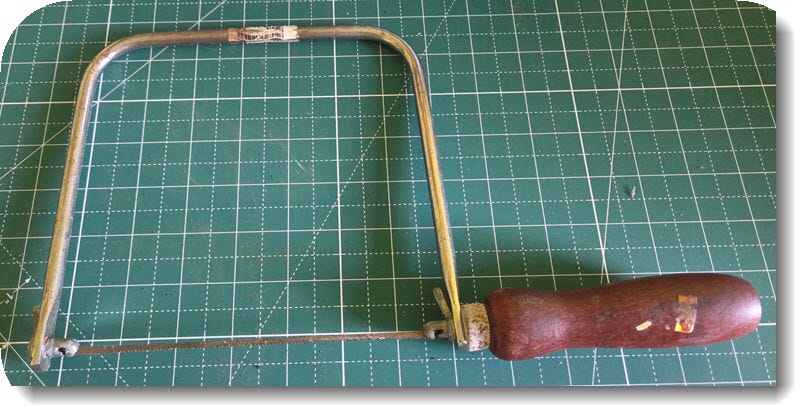
To use one, you install the first trim piece flush with the wall corner. Doesn’t need to be picture-perfect. After that, you cut the piece that adjoins it at a 45, and then cut out the excess wood, slightly angled. This is called… coping.
This allows you to adjust the angle to there’s no gap. It magically disappears!
I’d done it perfectly in the past… but this time I was starting to pull out what little hair I have left. I blamed it on the intricacy of the colonial style moulding, but in reality, I’d just lost my touch because I was out of practice.
Running out of patience (and wood trim), I finally just cut both at 45-degree angles and filled in the gap with wood putty.
Barely noticeable… except to me. When I look at it, it sticks out like a sore thumb (and I had plenty of those during the project, LOL).
“So Steve,” you ask. “What does this have to do with writing? Dude, we’re not cabinet makers here!”
Actually… more than you think, particularly in the age of artificial intelligence.
When writing, be careful of shortcuts and outsourcing
When muscles aren’t used, they atrophy and get weaker.
That includes the big gray squishy one between your ears.
I’m not saying you shouldn’t use AI as a tool. I do.
Just be careful how and when you use it.
The book I’m currently reading is “Cognitive Sovereignty – How to think for yourself when AI thinks for you” by Steve Raju.
I highly recommend it, by the way.
He doesn’t advocate you drop AI completely. It’s a tool. And tools help us with efficiency.
But efficiency doth not always equal effectiveness.
It was in this book I was first introduced to the term “cognitive sovereignty.”
He defines it thusly:
Cognitive Sovereignty is the innate capacity and moral right to form, direct, and protect your own thinking against manipulation, substitution, or erosion by any external intelligence.
Raju, Steve. Cognitive Sovereignty: How To Think For Yourself When AI Thinks For You (p. 13). Conversion Pioneers. Kindle Edition.
Let’s be honest here… artificial intelligence is, in fact, an external intelligence.
And not necessarily all that intelligent.
Understand the limitations of AI
There are a lot of things AI can do. At the same time, there are a lot of things it can’t.
One thing that it can do is kill your creativity. If you allow it.
Here’s an example.
Have you every had the “blank page blues?”
You sit there, trying to come up with something to write.
And that stinkin’ blinkin’ cursor on the screen seems to be taunting you.
“Okey, big boy! Whatcha gonna write now, huh? Whatcha gonna write?”
Oh, shut up.
Wait a minute… I can create a prompt and use my buddy Claude to give me some ideas!
Bingo!
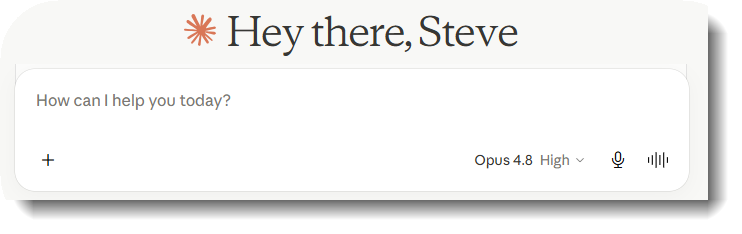
“Hey there, Steve! How can I help you today?”
“Well, dude. I need some ideas on what to write about. Can you give me 10 ideas on this topic and tell me why they’re important?”
And in less time than it take to pour a cup of coffee, the Claudster has 10 topic ideas with descriptions. And my coffee pot is just six feet away from the desk in my office.
So, I pick a good one and get to banging away on the keyboard.
This time.
Next time…
“Claudster, I really like idea #3 that you came up with. Can you do some research on it and show me the results?”
(Yes, Steve. I only use AI for research, too.)
Then after a while of doing this, there’s another prompt I might give to Claude. You know… just once.
“Hey buddy, this is some great research you handed me. Uh… just how would you structure an article about this topic using that invaluable research? You know… some kind of outline.”
“Not a problem, Steve. Here’s an outline, complete with a lead paragraph, along with subheadings and bullet points! That should give you a great start!”
Then one fine day… “Do you think you can give me a rough first draft?”
And somewhere deep inside that mass of gray matter I call my brain, a tiny creativity brain cell bursts into oblivion.
And then… another.
Learning to cope… again
Now that the bathroom’s finished, I thought I’d pick up the coping saw again to hone my skills and get them back.
Have some trim pieces left over and I’ll practice from time to time.
Getting better, I’m happy to say.
Not perfect… but on the way to it.
Same goes for my writing.
Some of you noticed I hadn’t posted for a while.
And a few of you, like my friend Casey, dropped me a note to ask where I’d been. If I was okay.
That was much appreciated, believe me.
I’d been in kind of a funk for a while. I was turning in work, good work, and my clients were okay with it. It worked for them.
But… it wasn’t working for me. I’d trained my Ais to write “like me,” but it wasn’t me. Not completely.
Something was a bit… off.
Barely noticeable, except to me. When I read at it, it stuck out like a sore thumb.
So, I’m learning to pull back on “external intelligence” and rely more on…
Internal intelligence.
Not perfect yet.
But well on the way to it.
It’s something I can… cope with.
Until next time,
Steve M.
P.S. I’m still working on the “finding your voice” series! Keep an eye out for it. It’s part of becoming an authentic writer.
I use AI as well for research and I give it strict instructions for reviewing what I write. But I don't let it write for me. Writing is just too much fun. How else would I know what's going on in my mind if I didn't have to first think about it before writing it down? Oh yeah... that reminds me. Thinking is fun too.
Love this article, Steve - you're right about keeping the brain "muscle" exercised. I love your writing, your voice, and your sense of humor. No AI could ever replace it.